Plymouth
In terms of modern architecture Plymouth is Devon’s jewel in the crown and could easily warrant a website of its ownAs a result of being one of the most heavily bombed UK cities in WW2 the city centre was largely reinvented when the council approved A Plan for the Future by Patrick Abercrombie & Paton Watson in 1944.Abercrombie proposed clearing the entire city centre and rebuilding either side of a central axis from the seafront Naval Memorial to the Station. This is called Armada Way with gardens and walkways. At the time of writing (January 2026), this has just been redefined, unifying the whole after several piecemeal interventions over the years. The first new buildings were Banks, Insurance companies, large shops and department stores. A common criticism of the architecture is that there is too much concrete, but in fact nearly all the buildings were dressed in Portland Stone and are of a similar height and mass, giving the Way a coherent whole, compromised in recent times by the hideous ‘Point’ student accommodation block at the the north end. Smaller shops and other buildings of interest run off the Way until you get to the southern end where there some spectacular civic buildings. A good way way get the impression of the plan is to walk down Armada way from the station.Below is a brief description some of the best buildings, some of which are open to the public.
English Heritage published an excellent book ‘Plymouth, Vision of a modern City’ by Jeremy Gould. Although out of print it is available as an Ebook from Liverpool University Press.
https://www.liverpooluniversitypress.co.uk/doi/book/10.3828/9781848020504


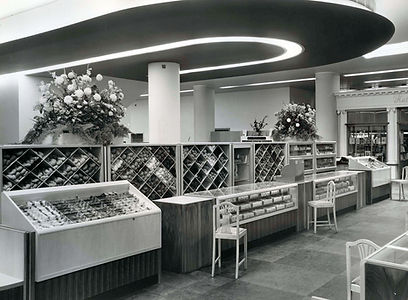


The Athenaeum. Wallis & Pearn 1961 Grade II Listed.
By the same architect as the Pannier Market but a very different architectural style, looking like a small Royal Festival Hall. The architects innovated with a steel space frame to span the auditorium. Well worth a visit - if you can get in.
The Guildhall. HWJ Sterling City Architect 1959 Grade II* Listed.The original building of 1870 was restored and modernised by Sterling adding a new entrance with undulating canopies. The highlight is the stunning interior. Jeremy Gould describes it as “one of the best and richest interiors of the 1950s” With artworks by David Weeks. Three magnificent Chandeliers represent the three towns of Plymouth.
https://historicengland.org.uk/listing/the-list/list-entry/1113280?section=official-list-entry
The Theatre Royal Peter Moro 1982. Grade II Listed
A later addition to the centre is the excellent Theatre Royal designed by Peter Moro who was part of the team that designed the Royal Festival Hall on the South Bank. It features an octagonal auditorium with a ceiling that can be raised and lowered to create different atmospheres and change the seating capacity. https://historicengland.org.uk/listing/the-list/list-entry/1457337?section=official-list-entry
Plymouth Civic Centre 1961 Jelllicoe Balantyne & Coleridge with H J W Stirling City Architect Grade II Listed.
The Civic Centre comprises two distinct areas. The tower block was designed as council offices with a public restaurant on the roof. Sitting next to it is the sumptuous Council Chambers building. The tower block was inspired by the Lever Building in New York by Skidmore Owings & Merrill. At the time of writing (Jan 26) the building remains empty since closing in 2015. Several proposals have been made for its development including from Urban Splash. Currently it is proposed to convert it into a mixed use building with housing and a training facility for the local college. This would involve replacing the outdated facia and glazing with floor to ceiling windows. The Council Chamber has wonderful etched glass by John Hutton, as well as a mural by Mary Adshead and painted panels by Hans Tisdall. The Chambers are lined with Ashburton Marble and high quality wood panelling.
https://historicengland.org.uk/listing/the-list/list-entry/1392038?section=official-list-entry
Dingles Department Store (House of Fraser) 1951 John Burnet, Tait & Partners
A four storey steel framed building clad in local Portland stone. Built on part of the site of the original Dingles. This was the first new department store since 1938. The building was renovated in the seventies including the installation of escalators.
Pannier Market Wallis & Pearn 1959 altered in 1999 Grade II Listed.
The wonderful Pannier Market is to the west of Armada Way and the major department stores. It is of a very different style to the other buildings. Working with Structural engineer Albin Chronowicz the architects created a space made from 7.45mtr wide concrete portal frames with no interruptions. A mezzanine floor at one end houses several cafes and the entrances both have murals by David Weeks It currently has an idiosyncratic range of small independent stalls and a wide range of cafes and street food venues. Recently it was sympathetically redecorated. Well worth a stop off for lunch.
https://historicengland.org.uk/listing/the-list/list-entry/1350321?section=official-list-entry
https://lloydellis.co.uk/david-weeks-a-sculptural-modernist/
Plymouth Lido (Tinside Lido) 1935 Grade II Listed
Built in the Art deco style and opened during WW2 the lido survrived several severe storms but in 1992 it closed due to decreased use, maintenance issues and running costs. After a vociferous local campaign it was renovated under the supervision of English heritage and reopened in 2003.
https://historicengland.org.uk/listing/the-list/list-entry/1271847?section=official-list-entry
The National Provincial Bank 1959 B C Sherren banks architects dept.
The Bank showed its commitment to contemporary architecture with a series of new banks the most notable being the bank at Plymouth. The design, which bears a striking resemblance to the Finland Station built in Leningrad at the same time, is a compelling synthesis of contemporary Scandinavian Modernism and the Festival of Britain style (its curved copper roof recalling that of the Festival Hall). Construction is a reinforced concrete frame largely clad in Portland stone, Dartmoor granite and High Broom hand-made facing bricks, with mosaics around the main entrance. Unfortunately the building is no longer accessible to the public.
https://historicengland.org.uk/listing/the-list/list-entry/1393429?section=official-list-entry


The Box & St Lukes Church AtkinsRéalis 2020
Central to a new cultural quarter in Plymouth the Box is an extension of the listed Museum. The space includes archives, a new exhibition gallery and cafeteria. The space between the Box and St. Lukes has been transformed into a multi use courtyard.