Public buildings of interest in Cornwall

The Eden Project. 2001 Grimshaw Architects, structural engineering Anthony Hunt Associates
The project was conceived by Tim Smit and Jonathan Ball,
Built on the site of a disused China Clay Mine.
Previously Tim Smit had been involved in the restoration of The Lost Gardens of Heligan.
The cladding panels themselves are created from several layers of thin UV-transparent ETFE film, which are sealed around their perimeter and inflated to create a large cushion. The resulting cushion acts as a thermal blanket to the structure.
Although seen by many as a tourist attraction it is also a serious research centre.
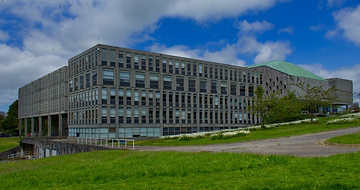
Truro County Hall 1966 Duchy Architect, Francis Kenneth Hicklin, and his successor, Alan Groves, 1966. Grade II Listed.
A three-storey square concrete-framed structure with circa 50 bays on each side; the bays contained a window on each floor flanked by concrete slabs.Internally, the principal room was the council chamber which was on the first floor and was cantilevered out of the main building on the east side.[2][8] There was a courtyard, landscaped by Sir Geoffrey Jellicoe, in the centre of the building; a sculpture by Barbara Hepworth, known as "Rock form, Porthcurno", was unveiled in the courtyard garden when the building opened.
Following the abolition of Cornwall County Council in April 2009, the building became the headquarters of the new unitary authority, Cornwall Council.] This was followed by an extensive programme of refurbishment works, to a design by Poynton Bradbury Wynter Cole of St Ives, which was completed in 2013.
The building contains an extensive collection of modern art including a painting by the Cornish fisherman and artist, Alfred Wallis, depicting the harbour entrance at Penzance.
https://historicengland.org.uk/listing/the-list/list-entry/1323700?section=official-list-entry

Falmouth Maratine Museum. 1996. Long & Kentish,
Unusually, both architects and designers were appointed at a very early stage in the project and worked closely together throughout the development.,
That has been achieved, in part, through design influenced by the site’s past as a boatbuilding yard, employing long-used and well-proved materials – granite, slate and green oak boarding, clad by master shipwrights.,

Tate St.Ives 1993 Eldred Evans and David Shalev Extension. 2017 Jamie Fobert Architects.
In 1988, the Tate group purchased a former gasworks and commissioned architects Eldred Evans and David Shalev, to design a building for the gallery in a similar style to the gas works. The building began in 1991, funded by the European Regional Development Fund, the Henry Moore Foundation and donations from the public] It included a rotunda at the centre of the gallery, looking over Porthmeor Beach and was completed in 1993.
In 2012, Tate St Ives ran a competition for a design team to build a major extension, which was won by Jamie Fobert Architects.[6]In January 2015, the Tate St Ives received £3.9 million to contribute towards the new extension, with the intention of doubling the available space in order to accommodate tourists throughout the year, without having to close between exhibitions.

Saltash Library 1963, Royston Summers of Cornwall County Council Architect’s Department. Grade II Listed
Reinforced-concrete frame construction with shuttered, rendered and rough-cast finishes. Slim-profile aluminium framed windows. Internally some original Nigerian walnut joinery survives.
The library is designed in a Brutalist style, based on the proportions of the human figure of Le Corbusier’s modular system. It references Le Corbusier’s Palace of Justice at Chandigarh (completed in 1956). The butterfly (or Y-shaped) roof has deep convex eaves which rise higher at the front. The principal double-height elevation faces west, and has aluminium framed, full-height glazing set back from the building line.
https://historicengland.org.uk/listing/the-list/list-entry/1474413?section=official-list-entry

Newlyn Art Gallery 2007 McInnes Usher McKnight.
The new pavilion was added to the existing Newlyn Art Gallery of 1895. The seaward side is a glass structure which supports a first floor with Cornish slate cladding. Large windows throughout give wonderful views of the the sea and Newlyn Green. The lower gallery has a small exhibition Gallery while the first floor has an education room and a Studio Cafe.

The Exchange Gallery. 2007 McInnes Usher McKnight
The Exchange is a converted Telephone Exchange. It has a large T-shaped gallery twice the size of the near by Newlyn Art Gallery. It has an undulating glass facade, which runs the entire length of the building. A dramatic light display designed by Penwith-based artist Peter Freeman illuminates the glass panels reflecting the exhibitions, time of day and year